
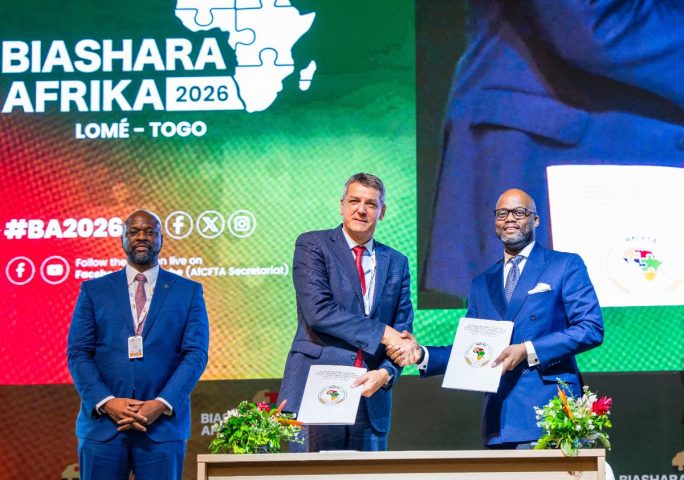
Rendeavour becomes the African Continental Free Trade Area’s inaugural implementation partner for African industrialisation and trade infrastructure
The African Continental Free Trade Area (AfCFTA) has partnered with Rendeavour, Africa’s new city builder, to support the implementation of the AfCFTA through infrastructure-led industrialisation, integrated economic zones and trade-enabling urban development across the continent an official statement in Lome,Friday,has disclosed.
Through the partnership, the statement said,Rendeavour will support the AfCFTA Secretariat across three priority areas: advancing the role of Special Economic Zones (SEZs) as drivers of industrialisation, mobilising private capital for trade- enabling infrastructure, and supporting the development of trade and industrial corridors linked to master-planned cities, logistics networks and integrated industrial hubs across the continent.
The partnership was signed on the margins of Biashara Afrika 2026, the AfCFTA Secretariat’s flagship private sector engagement platform, which convened heads of state and government, ministers, regulators, investors and business leaders to advance industrialisation, intra-African trade and private sector-led growth under the AfCFTA.
With a combined GDP of more than USD 3.4 trillion, AfCFTA is projected to unlock an additional USD 450 billion in income across the continent by 2035. Yet intra-African trade still accounts for only 14% of Africa’s total trade, while the continent hosts just 4% of the world’s Special Economic Zones — approximately 230 out of more than 5,400 globally.
Closing that gap requires moving from policy commitments to the development of physical infrastructure that enables trade at scale, including industrial zones, reliable utilities, logistic corridors and integrated mixed-use developments designed to support industries, workers and growing urban economies.
“Africa is not only the fastest growing region in the world; with time it will also become one of the safest and most reliable destinations for investment,” said Stephen Jennings, Founder and CEO of Rendeavour. “As we are beginning to see, this has profound implications for the movement of capital and know-how into Africa. As the first private sector implementation partner of AfCFTA, Rendeavour’s cities are recognised for their infrastructure and operating environments where investment, manufacturing and trade can thrive.”
Backed by American, Norwegian, New Zealand and British investors, Rendeavour’s cities in Nigeria, Kenya, Ghana, Zambia and the Democratic Republic of the Congo (DRC) are among the largest urban development projects in Africa, serving as hubs for businesses, residential communities, education and recreation within infrastructure-ready economic zones.
Current development across Rendeavour’s ecosystem is valued at more than USD 5 billion and includes 250 businesses, schools educating more than 6,000 students and 10,000 mixed-income homes.
Rendeavour’s pioneering SEZs – Tatu City in Nairobi, Kenya, and Alaro City in Lagos, Nigeria – have catalysed billions of dollars of domestic and foreign investment. Together with Kiswishi City in Lubumbashi, DRC, Jigna City in Abuja, Nigeria, Roma Park in Lusaka, Zambia, and Appolonia City and King City in Accra and Takoradi, Ghana, respectively, the cities have created more than 50,000 jobs in the past five years.
Companies that first established operations within Rendeavour’s ecosystem in Kenya have expanded to Nigeria and DRC – examples of the cross-border trade and industrial integration AfCFTA is designed to accelerate.
Businesses operating in Rendeavour’s cities include Zhende Medical, one of the world’s largest medical garment manufacturers, and Ariel Foods, a leading therapeutic food manufacturer, which export to dozens of regional and global markets.
H.E. Wamkele Mene, Secretary-General of the AfCFTA Secretariat, said, “The implementation of the AfCFTA requires strategic partnerships that can translate the opportunities of the Agreement into commercially viable industrial and trade ecosystems. Special Economic Zones, logistics platforms and integrated industrial infrastructure will play an important role in strengthening regional value chains, expanding manufacturing capacity and facilitating intra-African trade. This partnership reflects the growing confidence of the private sector in Africa’s single market and industrial future.”
SOURCE
RENDEVOUR NEWS