
This May, SST marks 20 years of advancing solutions to land-based waste and marine pollution across Africa.
Throughout this period, one insight has consistently shaped the organisation’s approach: the challenge is not a lack of effort, but rather a lack of connected systems, resulting in fragmented impact and missed opportunities to scale interventions that work.
From intervention to infrastructure
SST’s early efforts focused on awareness and behaviour change – a necessary foundation. But as work expanded, it became clear that awareness alone cannot shift outcomes at scale.
Behaviour change is dependent on accessible systems. Working infrastructure requires community buy-in and participation. Actionable policy requires implementation mechanisms on the ground.
Without alignment across these elements, progress remains fragmented.
The real work lies not only in delivering interventions, but also in building the infrastructure – social, institutional, and operational – that allows systems to function.
Collaboration as a system requirement
Over two decades, SST’s partnerships have evolved from supportive relationships into essential components of how systems operate.
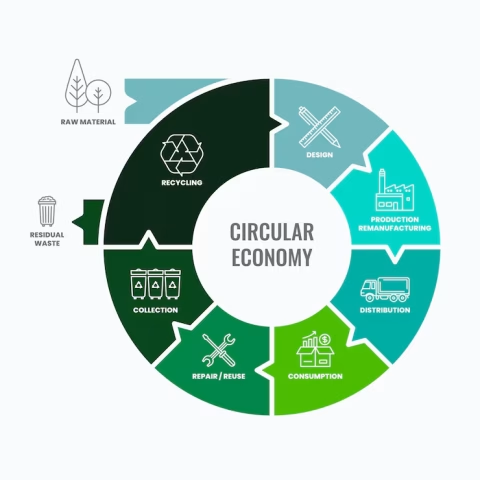
Working with communities, municipalities, businesses, and regional stakeholders has shown that circularity is only achieved through coordination across the value chain.
This is where many efforts across the sector continue to fall short: strong initiatives exist, but they are often working in isolation and are not connected in ways that enable scale. SST’s approach has been to address this gap directly by designing inherently collaborative interventions and by building the structures that enable stakeholders to operate as part of a connected system.
From programmes to platforms
As part of this response, SST’s work has shifted toward designing programmes as platforms for systems change.
Operation Clean Spot (OCS) is one such platform, connecting communities, collectors, schools, and businesses into functioning local waste systems that can be replicated and adapted.
At a continental level, the African Marine Network (AMN) extends this approach, creating the infrastructure for collaboration, knowledge exchange, and coordinated action across countries and sectors.
These are not standalone initiatives. They are purpose-built platforms designed to enable systems to function, adapt, and scale across diverse contexts.
Why this matters now
Africa’s circular economy is at a critical point. Momentum is growing, but without stronger system integration, impact will remain uneven.
For partners, funders, and practitioners, this presents a clear opportunity:
to invest in and collaborate on system-level solutions that can deliver impact at scale.
The next phase
SST’s next phase of work is focused on driving the scale of what works, not by replicating activities, but by strengthening the systems that support them in partnership with organisations committed to advancing circular solutions across Africa.
This means:
- Expanding platforms that enable collaboration and coordination
- Strengthening data, knowledge, and resource flows across the system
- Supporting locally rooted solutions that can scale through shared infrastructure
After 20 years, the direction is clear: systems change is not a long-term ambition, it is an immediate priority.
SOURCE
SST NEWSLETTER