
EcoRoads Article,first Published,June 9,2026
Why proper roadside drainage is the unsung foundation of safe, durable rural infrastructure , and what happens when it fails.
Water: The Road’s Quiet Adversary
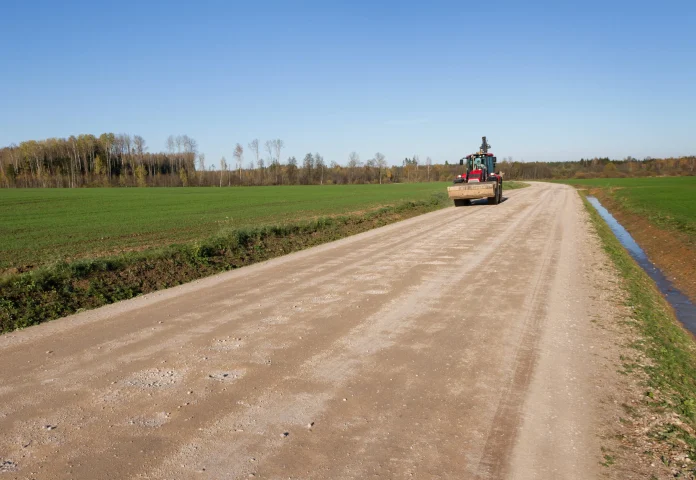
Drive along any well-maintained rural road and you might not think twice about the shallow ditches lining each side, the gentle crowning of the pavement, or the culverts hidden beneath at every low point.
Yet these unassuming features are working constantly — diverting, channeling, and dispersing the single greatest enemy of rural infrastructure: water.
In urban settings, extensive storm sewer networks handle runoff with relative efficiency. But rural and countryside roads often lack this underground infrastructure.
They rely instead on surface drainage — a system of ditches, swales, culverts, and carefully shaped road profiles — to keep water away from the roadbed. When that system works well, it is invisible. When it fails, the consequences can be severe, costly, and sometimes dangerous.
A road that drains well is a road that lasts. Drainage is not a supplementary consideration — it is the foundation of everything that comes after.
The Multiple Roles of Roadside Drainage
Effective roadside drainage performs several critical functions simultaneously. Understanding each helps explain why neglecting this infrastructure carries such a disproportionate cost.
Structural Integrity
Water weakens road base and sub-base layer, reducing their load-bearing capacity and accelerating pavement failure from below. Once saturation sets in, even moderate traffic loads accelerate damage far beyond what dry conditions would produce.
Road Safety
Standing water causes aquaplaning; eroded shoulders reduce safe driving width; flooded dips create sudden hazards. Poor drainage directly increases accident risk, particularly on high-speed rural roads where drivers have little warning.
Environmental Protection
Controlled drainage prevents polluted runoff, carrying sediment, fuel residues, and agricultural chemicals, from entering streams, wetlands, and agricultural land downstream.
Economic Savings
Every $1 invested in drainage maintenance saves an estimated $5–8 in future repair and reconstruction costs. Proactive drainage management is among the highest-return investments available in road maintenance.
Agricultural Access
Waterlogged or damaged roads cut off farms and rural communities during critical harvest and supply periods. Road closures during planting or harvest seasons can cause economic damage that far exceeds the cost of the road repairs themselves.
Erosion Control
Unmanaged water flowing along road surfaces strips topsoil, undermines verges, and silts watercourses downstream, compounding environmental damage well beyond the road corridor itself.
What Poor Drainage Actually Costs
The deterioration triggered by inadequate drainage rarely appears all at once. It accumulates gradually — and by the time the damage becomes visible to the casual observer, the underlying problems are already extensive.
Pothole formation. Water infiltrates pavement cracks, freezes in cold weather, and expands, shattering the surface from within. This cycle repeats until large sections of road disintegrate.
Base and Subbase saturation. When water penetrates the base layers, the structure beneath the road loses its load-bearing strength. Heavy vehicles create ruts; the surface sinks unevenly and cracks under stress.
Shoulder erosion. Uncontrolled runoff carves gullies into road shoulders, narrowing the effective carriageway and creating dangerous drop-offs beside the travelled surface.
Culvert blockages and flooding. Debris-choked culverts back water up against embankments, eventually overtopping or undermining them , sometimes causing complete road closures after heavy rainfall.
Landslips and embankment failure. Slopes saturated by persistently poor drainage can slip suddenly, taking sections of road with them in catastrophic and expensive failures.
Community isolation. In rural areas, a single washed-out or flooded road can cut off entire villages, farms, and businesses from emergency services and essential supplies for days or weeks.
Key InsightStudies from multiple authorities consistently find that more than two-thirds of unplanned rural road maintenance expenditure traces back, directly or indirectly, to drainage failures that could have been prevented through routine inspection and clearing. The costs of inaction compound each season.
How a Well-Designed System Works
Effective rural road drainage operates as an integrated system. Each component plays a specific role, and weakness in any one part can compromise the whole.
Road camber and crossfall — the slight convex crown of a properly shaped road — ensures that rainfall runs off the carriageway immediately rather than ponding on the surface. Even a modest 2–3% crossfall makes an enormous difference to surface water retention.
Side ditches and swales collect water running off the road surface and direct it away from the road structure. These channels must be regularly cleared of vegetation, silt, and debris to maintain their capacity, a task that is often deferred but that pays dividends when storms arrive.
Culverts and cross-drains allow water to pass beneath the road at natural low points and drainage channels. Their sizing, gradient, and condition are critical; an undersized or blocked culvert is often the single point of failure that leads to catastrophic flooding.
Cut-off drains and interception ditches are placed upslope of the road to intercept groundwater and hillside runoff before it reaches the road formation. On hilly countryside roads, these can be the most important element of all.
The following principles should guide all rural road drainage design and construction:
- Design comprehensively — address surface, side, and subsurface drainage as an integrated system, not independent elements.
- Match the design to the terrain — steep, flat, and problematic-soil areas each require a tailored drainage strategy.
- Size generously — the cost of a larger culvert during construction is trivial compared with the cost of emergency reinstatement after failure.
- Protect every outlet — unprotected discharges will erode; scour at outlets is the most common proximate cause of culvert and embankment failure.
- Compact backfill meticulously — poorly compacted fill around culverts and in trench backfills is the leading cause of joint failure and piping.
- Establish vegetation rapidly — bare disturbed soil is the most erosion-vulnerable condition; seed immediately after earthwork regardless of season.
- Maintain systematically — a drainage system that is not regularly inspected and cleared will fail; maintenance cost is always less than rehabilitation cost.
Rural road drainage is not a glamorous engineering discipline, but its quality determines whether a road asset remains serviceable for its intended design life or degrades rapidly into an expensive maintenance liability.
Investment in correct drainage design and construction — from the initial survey through to post-construction inspection — yields return measured in decades of serviceable road life.
01. Regular inspection programs
Twice-yearly inspections, ideally before winter and after spring thaw. Check to identify blocked ditches, silted culverts, and damaged drain outlets before they become emergencies.
02. Proactive vegetation management
Overgrown grass and leaf accumulation block ditch channels rapidly. Scheduled cutting and cleaning of roadside drains during drier months ensures capacity is available when it is needed most.
03. Culvert maintenance and upsizing
Existing culverts should be inspected for structural integrity and debris. Where climate projections indicate increased peak rainfall, culverts may need replacing with larger ones to handle greater flow volumes.
04. Re-profiling and regrading
Roads that have lost their camber through years of resurfacing without reshaping should be regraded so water sheds naturally to the sides — a relatively low-cost intervention with lasting benefits.
05. Community stewardship
Rural residents and landowners adjacent to country roads play a practical role: clearing ditches beside their property, avoiding agricultural runoff across road surfaces, and reporting problems to the highway authority.
06. Climate-adaptive design
New and reconstructed rural roads should be designed with future rainfall intensities in mind, incorporating larger drainage margins, sustainable drainage features, and permeable verges.
Investing in What Cannot Be Seen
The challenge with drainage infrastructure is that it does its best work invisibly. When ditches flow freely, when culverts pass water cleanly beneath a road, when a well-shaped carriageway sheds rain before it can penetrate — nothing dramatic happens. The road simply endures.
It is only when these systems are neglected that their importance becomes unmistakable, in the pothole that shreds a tires, the flooded crossing that blocks an ambulance, the crumbling shoulder that sends a vehicle into a ditch, the washed-out lane that isolates a farm for a fortnight.
For rural communities, the quality of their roads is inseparable from their quality of life. And the quality of rural roads is inseparable from the quality of their drainage. Addressing this infrastructure gap is not a technical nicety — it is a fundamental responsibility of those who manage and care for the countryside.
Proper drainage does not just extend the life of a road. It extends the reach and resilience of the community that road serves.
SOURCE
TerraFusion International,Inc
Below is the original article link and for more on ecoroads