
Introduction
A rural road is never only a road. For the communities it serves, it is the difference between a harvest that reaches the market and one that rots in the field; between a child who reaches school every day and one who is kept home when the track turns to mud; between a clinic an expectant mother can reach in time and one that lies beyond the reach of an emergency.
Across much of the rural and developing world, the absence of reliable, all-weather roads remains one of the most persistent barriers to economic opportunity, public health, and social inclusion. Yet conventional road construction — dependent on imported aggregate, heavy specialist plant, costly bitumen or concrete, and contractors brought in from distant cities — is frequently beyond the financial and logistical reach of the very municipalities that need roads most.
ECOROADS was developed to change that equation. As a state-of-the-art, enzyme-based soil stabilization solution, it allows durable, low-cost roads to be built largely from the soil already present along the alignment, using conventional earthmoving equipment and locally trained crews. But the value of ECOROADS extends well beyond engineering economy.
By placing the construction, renovation, and maintenance of roads within the practical and financial reach of local communities, it becomes an instrument of social development — a means to devolve responsibility to local authorities, create lasting employment, train a new generation of skilled workers, open access to markets and services, and build a genuine sense of ownership and pride in the infrastructure that communities depend on. The pages that follow set out those social benefits in detail.
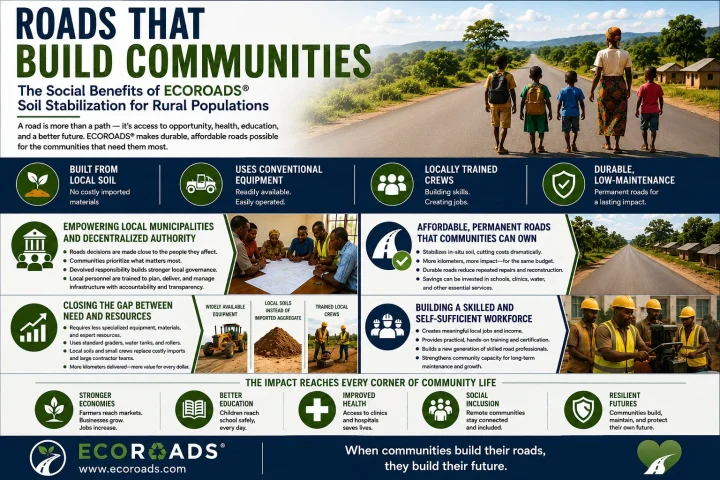
Empowering Local Municipalities and Decentralized Authority
A central objective of the ECOROADS approach is to enable local and rural road and infrastructure projects to be implemented directly by local municipalities and decentralized territorial authorities, as part of a deliberate devolution of responsibility from the central State.
When the power and the practical means to build and maintain roads are placed in local hands, decisions are made closer to the people they affect. Communities themselves can prioritize which roads matter most — the link to the grain silo, the route to the district hospital, the crossing that floods every wet season — rather than waiting for those choices to be made in a distant capital.
This decentralization is only meaningful if it is matched by capability. The ECOROADS model therefore pairs devolved responsibility with the concurrent development of qualified local personnel, so that authorities are not handed a mandate they have no means to fulfil. Local technicians, supervisors, and administrators are trained alongside the works themselves, building the institutional muscle that allows a municipality to plan, procure, deliver, and account for its own infrastructure.
Over time this strengthens local governance well beyond roads: it creates accountable institutions, transparent budgets, and a track record of delivery that communities can see and trust.
Affordable, Permanent Roads That Communities Can Own
ECOROADS is a sustainable and permanent solution for low-cost, affordable roads. Affordability is not a secondary virtue here — it is the very thing that makes local ownership possible.
Because the technology stabilizes the in-situ soil rather than relying on expensive imported materials and binders, the cost per kilometer falls dramatically, and a municipal budget that once stretched to a few kilometers of conventional road can now cover many times that distance. Roads that were previously unaffordable become achievable; networks that were previously aspirational become real.
Permanence compounds the benefit. A road that lasts, and that local crews can repair when it does not, breaks the destructive cycle in which scarce funds are spent building roads that wash away within a season or two. Money that would have gone to repeated reconstruction can instead be invested in extending the network, in schools, in clinics, in water.
For communities living on tight and uncertain budgets, a durable, low-maintenance road is not merely an asset; it is a source of financial stability and a foundation for longer-term planning.
Closing the Gap Between Need and Resources
Almost every rural authority faces the same arithmetic problem: the number of kilometers of road that the population needs vastly exceeds the civil-engineering resources available to deliver them.
There are too few qualified engineers, too little heavy equipment, too small a budget, and too short a working season. Conventional methods widen this gap, because they demand precisely the scarce, expensive, specialist resources that rural areas lack.
ECOROADS is designed to close it. By lowering the threshold of equipment, materials, and specialist expertise required to build a permanent road, the technology lets municipalities do far more with the resources they actually have.
Standard road graders, water tanks, and rollers — machines that are widely available or readily hired, replace fleets of special and sophisticated equipment. Local soils replace quarried aggregate. Trained local small crews replace extensive team of contractors. The result is more kilometers delivered per unit of money, equipment, and time, and a realistic path to closing the chronic shortfall between what communities need and what they have historically been able to build.
Building a Skilled and Self-Sufficient Local Workforce
Perhaps the most enduring social benefit of the ECOROADS approach is the creation of opportunity for thoughtful training of the local countryside workforce. The local labor force gains the opportunity to acquire lasting technical knowledge and hands-on experience in road construction and maintenance.
Through training and participation in project activities, workers learn safe equipment operation, fundamental civil engineering concepts, and the practical skills required to construct, rehabilitate, and maintain their own local road infrastructure. This capacity-building approach strengthens local expertise, promotes long-term self-sufficiency, and ensures that communities can effectively maintain and improve their road networks for years to come.
Skills, once acquired, stay in the community. A locally trained workforce can respond to damage quickly, carry out routine maintenance before small defects become expensive failures, and take on the next project without waiting for outside contractors to become available.
This self-sufficiency transforms the relationship between a community and its infrastructure: the road is no longer something done to the community by outsiders, but something the community knows how to build and keep. The same skills are transferable to other construction and infrastructure work, raising local earning power and creating a pool of capable tradespeople where none existed before.
Opportunity and Inclusion for Young People
Rural areas across the world share a common challenge: too few opportunities for their young people, who too often must choose between unemployment at home and migration to overcrowded cities. Implementation of ECOROADS solution is built to offer a different path.
It provides methodological support for the planning and implementation of local community development aimed squarely at young people, giving them structured, practical pathways into meaningful work and lifelong skills.
Crucially, this opportunity welcomes young people from all backgrounds, regardless of their education level, social status, or previous work experience. It provides a pathway for those who are often excluded from formal employment due to limited qualifications or opportunities, enabling them to develop practical skills, gain valuable work experience, and earn a sustainable income.
By creating meaningful local employment, it helps reduce rural out-migration, retains talent and ambition within the community, and empowers a new generation to become the builders, maintainers, and stewards of their own infrastructure and future development.
Jobs, Mobility, and Access to Markets
By bringing new technology to meet today’s growing demand for safe, sustainable roads, the ECOROADS approach creates jobs for local labor at every stage — survey and preparation, mixing and stabilization, compaction and finishing, and the ongoing maintenance that follows. These are not transient jobs that vanish when an outside contractor leaves; because the workforce is local and the skills remain, employment is sustained across the life of the network.
Beyond the direct jobs, good roads unlock the wider rural economy. They facilitate free movement to and from markets, allowing farmers to sell their produce before it spoils, to reach more buyers, and to command fairer prices instead of accepting whatever a single intermediary will offer. Lower transport costs leave more income in local hands.
Reliable, all-weather access encourages traders, services, and small enterprises to operate where impassable roads once made business impossible. Safe transport reduces the accidents and breakdowns that plague rough tracks, and it shortens journeys that once consumed whole days, time that families can return to farming, schooling, and earning. In this way a single road radiates economic benefit far beyond its own surface.
Health, Education, and Everyday Quality of Life
The human benefits of dependable rural roads are profound and immediate. An all-weather road means a sick child or an expectant mother can reach a clinic when minutes matter, and that medicines, vaccines, and health workers can reach the village in return. It means children can attend school consistently rather than missing weeks each rainy season, and that teachers are willing to be posted to communities they can actually reach.
It means the elderly and people with disabilities are no longer isolated by terrain. Each of these is a quality-of-life gain that compounds over a lifetime, and each becomes possible the moment a community gains a road it can rely on in every season — and keep in good repair through its own efforts.
Environmental Responsibility
Economic and social progress do not have to come at an environmental cost. ECOROADS is an environmentally responsible and innovative soil stabilization technology. It is bio-based, non-toxic, non-corrosive, non-combustible, and biodegradable. Because the technology stabilizes existing on-site soils, it significantly reduces the need for quarrying, crushing, and long-distance transportation of aggregates required by conventional road construction methods.
As a result, it helps lower greenhouse gas emissions, reduce dust generation, and minimize the environmental impacts associated with material extraction and transport.
Roads stabilized with ECOROADS are also more resistant to moisture, erosion, and extreme weather conditions, making them better suited to withstand the challenges of a changing climate. For rural populations whose livelihoods are closely tied to the land and natural environment, sustainable infrastructure is not merely an environmental objective – it is essential to both present and future well-being.
National Pride and Social Cohesion
When a community builds its own road, with its own people, its own hands, and its own soil, something changes that no contractor delivering a finished product from outside could ever provide. The road becomes a shared achievement. The workers who built it, the young people who learned their trade on it, and the families who travel it daily all share in a visible, lasting symbol of what their community can accomplish.
This instils a strong sense of national pride and local identity, and it knits communities more tightly together around a common purpose. Pride of ownership also protects the investment: people care for what they have built themselves, and a road the community is proud of is a road the community will maintain.
Conclusion
The case for ECOROADS implementation rests on far more than the cost-effective and sustainable construction, maintenance, and rehabilitation of roads—although it delivers all of these benefits. Its deeper promise is social.
By empowering local municipalities to take greater responsibility for their road networks and by developing the capacity of local people to manage and maintain them, ECOROADS makes durable, high-quality roads affordable and accessible to the communities that depend on them. It helps bridge the long-standing gap between rural needs and available resources by training a skilled local workforce, creating employment opportunities, and opening doors to young people from all backgrounds.
In doing so, it enables communities to develop the knowledge, skills, and self-reliance needed to sustain their infrastructure for the long term.
At the same time, improved roads provide reliable access to markets, healthcare, education, and other essential services, supporting economic growth and improving quality of life. Delivered through an environmentally responsible approach that minimizes resource consumption and environmental impact, ECOROADS transforms road construction into a catalyst for community development.
By meeting the growing demand for safe, sustainable, and affordable road infrastructure—and the mobility and connectivity it enables—ECOROADS offers rural populations not only better roads, but also greater opportunity, resilience, dignity, and pride in the future they are building for themselves.
SOURCE
TERRAFUSION INTERNATIONAL INC