
By Hariharan Sundararajan
Founder & President, Global Gold Policy Institute (GGPI)
Gold has always occupied a unique position in the global economy. It is simultaneously a commodity, a financial asset, a store of value, a reserve instrument, and a strategic resource. Yet despite its importance, discussions surrounding gold often remain fragmented—focusing separately on mining, refining, trading, investment, or jewellery manufacturing, rather than viewing the gold ecosystem as an interconnected whole.
Today, however, structural changes in the global economy are creating an opportunity to rethink how international gold markets can evolve. As geopolitical dynamics shift, supply chains are reconfigured, and responsible sourcing becomes increasingly important, there is growing recognition that stronger regional cooperation will be essential for building more transparent, resilient, and sustainable gold markets.
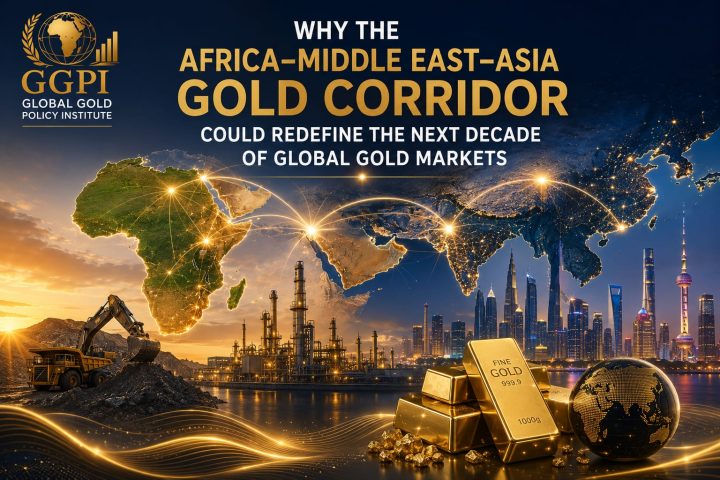
One of the most significant developments is the emergence of the Africa–Middle East–Asia (AMEA) corridor as an increasingly interconnected economic and strategic gold ecosystem.
A Natural Economic Partnership
Africa is home to some of the world’s richest gold reserves and remains one of the largest producing regions globally. Across the continent, governments are placing greater emphasis on responsible mining, value addition, artisanal mining formalisation, and improving governance of mineral resources.
The Middle East has developed into one of the world’s leading centres for refining, logistics, bullion finance, and international precious metals trade. Its geographic position, sophisticated infrastructure, and financial connectivity naturally link producing countries with global markets.
Asia, meanwhile, represents the world’s largest concentration of gold demand. Beyond jewellery consumption, the region hosts advanced manufacturing industries, internationally recognised financial centres, commodity exchanges, institutional investors, and rapidly expanding technology ecosystems that increasingly influence the future direction of global bullion markets.
Viewed together, these three regions represent complementary strengths rather than competing interests.
Moving Beyond Traditional Supply Chains
Historically, gold has often been viewed simply as a sequence of transactions—from mine to refinery to market. Increasingly, however, the conversation is expanding.
Responsible sourcing, digital traceability, trade finance, ESG expectations, technology innovation, financial inclusion, and international cooperation are becoming integral components of modern gold ecosystems.
Building stronger connections between producing countries, refining centres, financial institutions, logistics providers, technology companies, and downstream markets can improve transparency while creating greater economic value across the entire supply chain.
The future of gold markets will depend not only on production volumes but also on the quality of institutions, infrastructure, governance, and partnerships that support them.
Why Policy Matters
Many of the challenges facing global gold markets cannot be addressed by commercial participants alone.
Responsible sourcing requires effective public policy.
Trade finance depends upon strong financial institutions.
Cross-border investment requires regulatory confidence.
Digital traceability requires interoperable standards.
Sustainable mining depends upon environmental stewardship, community engagement, and long-term governance.
This is why policy dialogue is becoming increasingly important.
Governments, regulators, industry associations, financial institutions, technology providers, research organisations, and development partners all have complementary roles in strengthening international gold markets.
Rather than replacing existing institutions, greater coordination among stakeholders can help improve resilience while respecting national sovereignty and existing regulatory frameworks.
Technology as an Enabler
Digital technologies are also reshaping the gold industry.
Artificial intelligence, blockchain-enabled verification, Digital Product Passports, secure data exchange, satellite monitoring, and advanced analytics offer new opportunities to improve transparency, efficiency, and market confidence.
Importantly, technology should complement governance—not replace it.
The objective is to strengthen trust, simplify compliance, and support more efficient international collaboration while maintaining appropriate safeguards for privacy, cybersecurity, and national regulatory requirements.
Building Resilient Markets
Recent geopolitical events have demonstrated the importance of resilient supply chains and diversified international partnerships.
Gold markets are no exception.
Greater cooperation across Africa, the Middle East, and Asia has the potential to strengthen investment, improve logistics connectivity, enhance financial inclusion, encourage downstream value addition, and support sustainable economic development.
At the same time, stronger collaboration can contribute to more stable and trusted international markets capable of adapting to future economic, technological, and geopolitical change.
A New Conversation
The purpose of this discussion is not to advocate the creation of new supranational institutions or to duplicate the valuable work already undertaken by governments, industry bodies, commodity exchanges, refiners, financial institutions, and international organisations.
Instead, it is to encourage a broader conversation about how existing capabilities can be better connected through policy dialogue, research, institutional partnerships, and knowledge sharing.
As the gold industry continues to evolve, cooperation may become one of its most valuable assets.
Looking Ahead
Recognising the need for an independent platform dedicated to evidence-based policy research and international dialogue, the Global Gold Policy Institute (GGPI) has recently been established to contribute to discussions on gold policy, monetary systems, responsible sourcing, financial markets, and institutional cooperation.
Over the coming weeks, GGPI will publish its inaugural flagship policy framework exploring how stronger collaboration across Africa, the Middle East, and Asia can contribute to more transparent, resilient, and sustainable global gold markets.
The publication is intended as the beginning of a longer-term research agenda—one that seeks to foster informed discussion, practical policy recommendations, and international collaboration for the future of the global gold ecosystem.
As global markets continue to evolve, the future of gold will depend not only on where it is produced or traded, but on how effectively nations, institutions, and industry work together to build trusted, resilient, and inclusive value chains for generations to come.
About the Author
Hariharan Sundararajan is the Founder & President of the Global Gold Policy Institute (GGPI). GGPI is an independent policy research institute dedicated to advancing research, international dialogue, and strategic collaboration on gold policy, responsible sourcing, monetary systems, and the future of global bullion markets.