
By: Mohammed A. Abu
Introduction
The rising climate change impact on built environments globally has since called for Climate Smart Buildings (CSBs) otherwise termed a “Green Building”.. That is, structures designed, built, and operated to reduce greenhouse gas emissions while adapting to climate risks like extreme heat, flooding, and severe weather.
It is generally accepted globally that, Africa contributes less than 4% of global greenhouse gas emissions, yet it faces severe climate impacts—including rising temperatures, floods, droughts, cyclones, and coastal erosion—that threaten cities, homes, and infrastructure.
According to the African Development Bank Group (AfDB), the key climate pressures on the Built Environment are extreme weather and sea-level rise: Floods, droughts, cyclones, and coastal erosion damage buildings, transport corridors, and low-lying settlements.
Need for Sustainability
The context/Justification
Climate-resilient engineering designs, builds, and maintains Africa’s physical assets—such as roads, buildings, power grids, and water systems—to withstand extreme weather and long-term climate shifts. With roughly 70% of Africa’s 50-year infrastructure still unbuilt, engineers have a major opportunity to embed adaptation from the start rather than retrofitting after disasters.
It is therefore against this background that, the relevance and importance of the affirmative action approach taken by the African Continental Engineering and Construction Network(ACECN) in 2023 leading to the birth of ACEACRES in 2023 could be best appreciated.
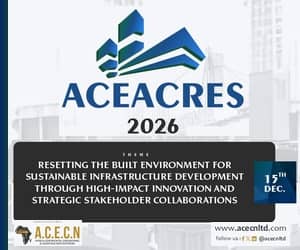
During ACEACRES 2026,participants will examine the potential of artificial intelligence, digitalization, modern construction methods, sustainable materials and innovative financing models to improve how infrastructure is planned, financed, designed, constructed and maintained.
What Research Papers in Economics say
Various research papers state that higher temperatures increase pressure on indoor thermal comfort and push energy demand up as buildings rely more on cooling while rapid urban growth alongside limited budgets and over-extraction of local materials (such as marine sand) increases vulnerability in growing cities and informal settlements.
Resource strain and informal growth: Rapid urban growth alongside limited budgets and over-extraction of local materials (such as marine sand) increases vulnerability in growing cities and informal settlements.
Core Sustainability and Resilience Strategies
Bioclimatic and passive design: Using natural ventilation, shading, thermal mass, and passive solar principles helps maintain indoor comfort while cutting energy use.
Local and low-carbon materials: Expanding use of compressed earth, timber, bamboo, and agricultural-residue materials can reduce reliance on imported, carbon-intensive inputs like cement and protect fragile ecosystems.
Climate-resilient engineering and water management: Updating building and civil engineering standards, integrating climate projections, and adopting rainwater harvesting or greywater reuse strengthen long-term durability.
Policy frameworks and smart tools: National energy-efficiency building codes, digital monitoring tools, and continental commitments under African Union Agenda 2063 and the Africa Manifesto for Sustainable Cities & the Built Environment support broader adoption.
Balancing near-term needs and long-term resilience: Governments and builders must address housing backlogs, basic services, and climate adaptation simultaneously rather than treating them in isolation Research Papers in Economics.
What the World Green Building Council says
Main Bottlenecks
Limited capital and high upfront costs, the Council notes, slow down resilient construction and building retrofits, driving calls for more accessible climate and adaptation finance.
The Clarion Call on African Cities
African cities recently were asked to move from reactive infrastructure management to proactive data-driven approaches to improve resilience, sustainability and the efficiency of urban systems.
The call was made during a technical session on Climate-Resilient Infrastructure & Sustainable Cities” at the 12th UNESCO Africa Engineering Week and 10th African Engineering Conference in September 2026.
The Session-chaired by Ing Sylvia Sampong Ekremet of Ghana and Eng.Keneilwe Thejane of South Africa, examined approaches to road infrastructure management, sustainable construction materials and urban mobility.
Kaslyn Naidoo, a civil Engineering Technologist from South Africa presented an approach to pavement-condition assessment that combines functional and structural data with technologies such as Ground Penetrating Radar (GPR) and automated image analysis.
The approach can help identify deterioration that may not be visible through conventional inspections allowing road agencies to detect problems earlier and better target maintenance.
Key Roles of Engineers
- Updating codes and models: Engineers are shifting from historical weather averages to predictive climate models and updated building standards that account for heavier rainfall, heat waves, and rising sea levels.
- Flood and drainage management: Designing larger culverts, sustainable urban drainage, and flood-resistant structures helps reduce damage in flood-prone cities and coastal corridors, such as Accra, Lagos, and Abuja.
- Geotechnical and site suitability: Proper soil and site assessments prevent structural cracking, erosion, and foundation failure in unstable ground or high-risk zones.
- Energy and transport durability: Engineers use higher-temperature conductors for power lines and reinforce roads and bridges against washouts, heat stress, and longer disruption periods.
- Nature-based and green solutions: Combining engineered structures with wetlands, green spaces, and energy-efficient building designs reduces runoff, urban heat, and grid strain.
Core Implementation Challenges
- Financing gaps: Adaptation in Africa requires an estimated $50 billion annually, making bankable risk screening—such as integrating climate vulnerability into project appraisal by institutions like the Ghana Infrastructure Investment Fund (GIIF)—essential.
- Governance and enforcement: Stronger coordination across municipalities, national ministries, and built-environment professionals is needed to turn resilience plans into enforced local standards.
As the African Development Bank notes, building climate resilience into upcoming projects protects vulnerable communities and lowers long-term recovery costs.
Research from Academic City University College also emphasizes pairing technical engineering with systems thinking and stronger governance.