
…As 2nd Mining in Motion Summit ends in Accra
by Mohammed A. Abu
Accra-The African Minerals Policy Forum – Mining in Motion Summit 2026 (AMPF–MiM 2026), ended in Accra, Wednesday, with the important contributive role of Artisanal and Small-Scale mining (ASM) sector to national economies given a major spotlight, the need for its formalization and peaceful co-existence between it and its Large-Scale Mining Sector (LSM) counterpart as well as an announcement about a processing hub for them
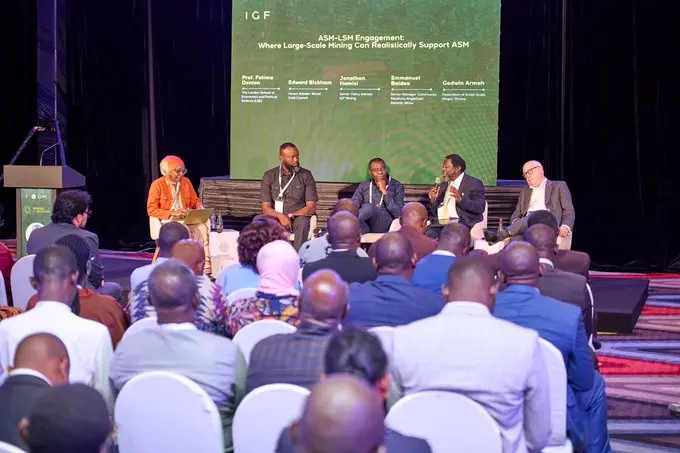
A number of presentations and panel sessions were held on the closing day of the event with particular reference to the one that discussed the topic, “Government-Large Scale Mining Relations: Building Stronger Partnerships for Shared Prosperity” that sought to address the critical intercession of industrial mining and local livelihoods, and brought together industry executives, regulatory institutional heads and policy experts.
Edward Bickham, Senior Adviser to the World Gold Council, opening a panel discussion outlined targeted global initiatives aimed at transforming the small-scale sector through technology and formalization. He said there was an ongoing gold processing program, built on three core pillars: formalizing miners, removing harmful mercury from the supply chain, and dramatically improving ore recovery rates.
“Increasing gold recovery from a typical 30% up to 90% resolves one of the fundamental conundrums of formalization,” Bickham explained. “By significantly elevating processing efficiency, we generate substantial additional value that directly boosts miners’ incomes while providing governments with the tax revenue needed to fund long-term formalization programs. To protect these gains, we are integrating strict traceability protocols directly at the ore level to guarantee that gold entering the value chain originates from legal, verified sources.”
Reaffirming the government’s commitment to inclusive industry growth, Maxwell Yao Akpene Klu, Deputy CEO of Small-Scale Mining and Industrial at the Minerals Commission of Ghana, underscored the massive economic output of small-scale miners. Klu revealed that small-scale operators contributed 3.4 million ounces of Ghana’s total 6 million ounces of gold production, demonstrating the sector’s immense potential. He expressed appreciation for the World Gold Council’s financial backing on supply chain traceability and highlighted ongoing collaboration with the Chamber of Mines to establish a joint operational framework.
“The small-scale and large-scale sectors are not in conflict—we operate as a unified community focused on peaceful coexistence,” Klu affirmed. “Our objective is to build structured mechanisms that allow both sectors to thrive, safeguard our environment, and ensure that mineral wealth drives shared economic prosperity for all stakeholders. “He intimated.
Ghana’s mining sector, Ing. Frederick Attakumah, President of the Ghana Chamber of Mines, a co-panelist underscored gold’s central role as a primary stabilizer of the national economy while also noting that, it historically accounts for roughly 40% of Ghana’s export earnings, a figure that surged to nearly 63% last year.
“The stabilizing impact of gold on the Ghanaian economy is immense—recent economic recovery and the decline of inflation to 5.6% have been directly anchored by growth in the gold sector, with the small-scale segment playing a crucial role,” Attakumah stated while also cautioning that “sustainable growth depends entirely on environmental stewardship”. “The priority moving forward must be formalization, particularly addressing environmental challenges. The Chamber, Mr. Attakumah disclosed, is currently finalizing the first phase of a comprehensive study to establish formal cooperation guidelines between large and small-scale operators, ensuring responsible, environmentally sound mining across the small-scale sector.”
Craig Jones, CEO of Perseus Mining, on his part underscored the role of LSM operators in fostering sustainable mining ecosystems. Highlighting Perseus’ expanding African portfolio, Jones noted that the company is actively deploying capital across Ghana, Côte d’Ivoire, and Tanzania—where a $125 million investment in a project acquired three years ago is on track for operational launch by January 2027. Addressing the persistent challenge of illegal mining, Jones emphasized that structural coexistence requires top-level institutional frameworks.
“Overcoming illegal mining starts with industry bodies like the Chamber of Mines establishing clear, enforceable governance frameworks for LSM and ASGM sectors to co-exist,” Jones stated. “Large-scale miners have a direct responsibility to support sustainable practices, ensuring that environmental management, safety, and social development are prioritized across the broader mining community.”
Godwin Armah of the Federation of Small-Scale Miners in Ghana noted that adversarial relations between the two mining divides ought to be avoided and should rather be based on peaceful co-existence while also calling for land allocation to consider both small-scale and large-scale operators in order to prevent conflict.”
Ms. Ngoge Diop, the Director of the Sub-Regional office for West Africa of the United Nations Economic Commission for Africa (UNECA) proposed the establishment of a regional Artisanal and Small-Scale Mining (ASM) processing hub designed to fast-track the continent’s mining growth agenda through greater inclusion, local value addition, and economic empowerment.
Ms. Ngoge in her announcement highlighted the immense opportunity presented by the global green energy transition. “Driven by the energy transition, global demand for cobalt and lithium is projected to triple by 2050, offering a unique opportunity to transform Africa’s economic landscape,” Diop stated. Pointing to regional successes, she noted that Ghana generated $21 billion from gold exports in 2025 alone, demonstrating the immense fiscal impact precious metals can deliver when properly harnessed.
Diop emphasized that the proposed hub aligns directly with the African Mining Vision (AMV)—specifically its fourth program cluster focused on ASM formalization—and leverages the African Continental Free Trade Area (AfCFTA) to build integrated regional markets. With the ASM sector supporting 14.2 million direct jobs across Africa, the hub will connect technical assistance and capacity building with downstream processing. “Our ambition must extend to building viable businesses that add value to our resources right here on the continent,” she added.
Backing the flagship initiative, representatives from the Open Society Foundations (OSF) underscored the critical socio-economic footprint of artisanal miners.
Globally, while large-scale mining employs roughly 7 million people, the ASM sector directly employs 45 million and supports more than 225 million livelihoods, predominantly across Africa.
Organized by the Ashanti Green Initiative, led by the Chief Executive Officer, Ohene Kwaku Duah, in partnership with the African Union and the government of Ghana, the three-day event themed, “One Continent. One Voice on Minerals. Aligning Africa’s Mineral Wealth Future”, which offered twenty (20+) conference seminars, attracted six hundred (600+) attendees, sixty-two (62+) Speakers, and representatives of fifty (50+) private corporates from within Ghana, across the various African sub-regions, the US, the UK among others.
Core Aims and Objectives
The event was intended to address Continental Policy Alignment, Moving from Raw Exports to Value Capture, Advancing the African Mining Vision (AMV), Combatting Illegal Small-Scale Mining (Galamsey), Formalizing Artisanal and Small-Scale Mining (ASM), Environmental Reclamation and Reforestation, Economic Diversification and Livelihoods as well as, Leveraging Critical Minerals for the Energy Transition
Sponsors
- Platinum Sponsor: AngloGold Ashanti
- Gold / Gold Plus Sponsor: AngloGold Ashanti (Gold Plus)
- Silver Plus Sponsor: Rand Refinery
- Silver Sponsors: Royal Ghana Gold, Alpha Stream, Asanko Gold Ghana
- Institutional / Development Sponsors: World Bank
- Additional Sponsors: Perseus Mining, BOST Energies, and Stanbic Bank
- Official Travel Partner: Wakanow Ghana
Plenary and Open Sessions
The high-level plenary and opening sessions featured prominent African leaders, including Ghanaian President H.E. John Dramani Mahama and Liberian Vice President Jeremiah Kpan Koung.
The key takeaways from the summit’s main discussions included:
Shifting from Raw Resource Extraction to Local Processing
A core theme championed by Ghana’s President Mahama was ending the paradox of mineral-rich African nations remaining economically impoverished. Leaders called for an immediate shift away from exporting raw mineral ores toward value-added industrialization, including: Building domestic refineries and processing plants to capture local value and create jobs, establishing an ambitious target to end raw mineral ore exports by 2030, enhancing downstream industries to power Africa’s own industrial revolution using its copper, bauxite, and lithium reserves.
Combating and Regulating Illegal Small-Scale Mining (Galamsey)
Addressing the environmental crisis caused by illegal small-scale mining was a top policy priority. Key interventions outlined during the sessions included:
Strict Legislative Protections
Enacting bans on mining in water bodies and forest reserves, alongside protective laws for cocoa farms.
Decentralized Licensing
Modernizing and overhauling the mining licensing regime to grant district-level offices the legal mandate to formally register and regulate small-scale miners.
Technological Oversight
Deploying state-of-the-art technologies, such as artificial intelligence (AI) and digital tracking frameworks, to monitor excavators, heavy earth-moving equipment, and chemical usage.
Environmental Reclamation and Alternative Livelihoods: Acknowledging the severe destruction of over 5,500 hectares of forest reserves, the summit highlighted practical rehabilitation initiatives:
The “Tree for Life” Project: An economically engaging re-afforestation campaign driven by youth employment.
The Blue Water Initiative: A strategic clean-up partnership designed to restore heavily polluted water bodies.
Commercial Farming: Programs aimed at converting recovered illegal mining sites into zones for commercial crop production, offering alternative livelihoods to youth and former illegal miners.
Coordinated Continental Policy for the AU Chairmanship: A major structural takeaway of the 2026 summit is that the compiled ministerial roundtable recommendations will directly serve as a guiding policy roadmap for President Mahama as Ghana prepares to assume the African Union (AU) chairmanship. This move aims to align mining codes across the continent, strengthen regional value chains, and unify Africa’s voice when negotiating global critical mineral supply chains.
Local Supply Chains & Shared Prosperity: The sessions emphasized the need for large-scale mining enterprises to build deeper partnerships with local economies. Rather than importing all operations infrastructure, companies were urged to aggressively procure local goods (such as domestic steel balls, industrial chemicals, and limestone-derived products) to retain mining revenue within host countries.The “Accra Reset” & Continental
Policy Alignment: The summit focused on unifying fragmented African mining policies to leverage the continent’s control over roughly 30% of global critical mineral reserves and 25% of annual gold output.
Gold Reserve Accumulation & Strategic Sovereignty: Highlighted Ghana’s Accelerated National Reserve Accumulation Policy, under which the country secured a landmark MOU with large-scale miners to reserve 30% of gold output for national strategic central-bank reserves
Combating Galamsey & Environmental Restoration: President Mahama and Minister for Lands and Natural Resources Hon. Emmanuel Armah-Kofi Buah addressed the ecological crisis of illegal small-scale mining (Galamsey), which has severely damaged forests and water bodies
Other African nations (including Tanzania, Uganda, and the DRC) shared parallel frameworks to bolster foreign exchange resilience.
Commitments
Key commitments included reforming small-scale mining licensing, tracking heavy machinery (like excavators), expanding the Tree For Life land reclamation initiative, and encouraging large-scale operators to partner with artisanal cooperatives.
Local Procurement & Domestic Industrialization
Academic and industry contributions—such as from the University of Mines and Technology (UMaT)—emphasized deepening local supply chains (e.g., domestic sourcing of steel balls by companies like Newmont) and investing in cleaner, non-cyanide gold processing technologies.
Key Political Leaders
H.E. John Dramani Mahama (President of Ghana), H.E. Joseph Boakai (President of Liberia), H.E. Wamkele Mene (Secretary-General of AfCFTA), and Mathias Cormann (OECD Secretary-General),Organizer / Coordinator: Oheneba Nana Kwaku Duah (CEO of the Ashanti Green Initiative).