
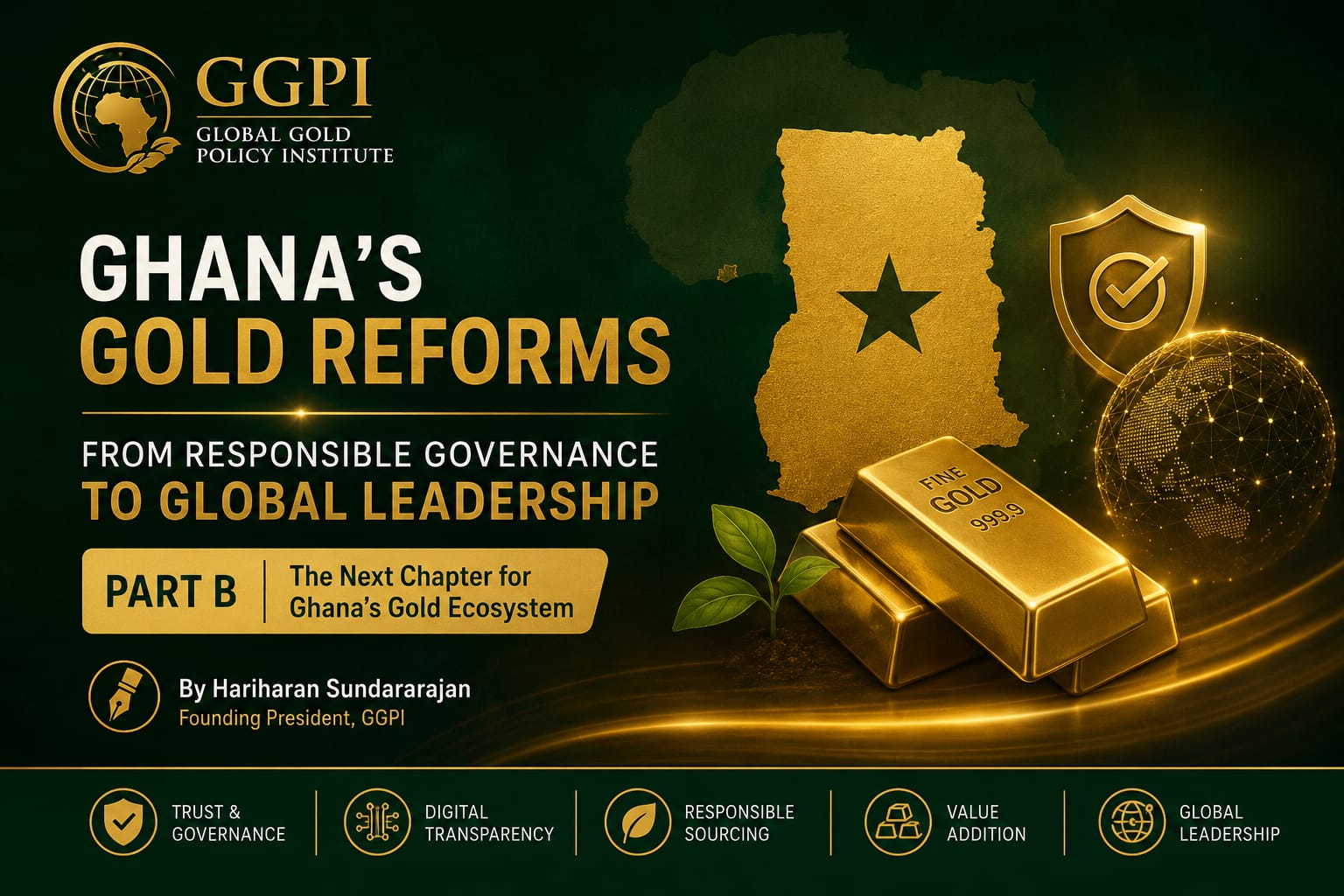
𝐏𝐚𝐫𝐭 𝐁 | 𝐓𝐡𝐞 𝐍𝐞𝐱𝐭 𝐂𝐡𝐚𝐩𝐭𝐞𝐫 𝐟𝐨𝐫 𝐆𝐡𝐚𝐧𝐚‘𝐬 𝐆𝐨𝐥𝐝 𝐄𝐜𝐨𝐬𝐲𝐬𝐭𝐞𝐦
By Hariharan Sundararajan
Founding President, Global Gold Policy Institute (GGPI)
𝐓𝐡𝐞 𝐆𝐥𝐨𝐛𝐚𝐥 𝐆𝐨𝐥𝐝 𝐌𝐚𝐫𝐤𝐞𝐭 𝐢𝐬 𝐂𝐡𝐚𝐧𝐠𝐢𝐧𝐠
The future of gold governance will increasingly be determined by a question that extends well beyond production:
Can a country demonstrate that its gold can be trusted?
Trust is becoming a strategic asset in international bullion markets.
The world’s major refiners, financial institutions, investors and increasingly sophisticated consumers are placing greater emphasis on provenance, responsible sourcing, environmental performance, chain of custody and regulatory integrity.
This creates a strategic opportunity for Ghana.
The country’s objective should not simply be to produce more gold. It should be to make Ghanaian gold among the most trusted gold in the world.
That distinction could fundamentally change Ghana’s position in the global value chain.
𝐑𝐞𝐬𝐩𝐨𝐧𝐬𝐢𝐛𝐥𝐞 𝐆𝐨𝐥𝐝 𝐌𝐮𝐬𝐭 𝐁𝐞𝐜𝐨𝐦𝐞 𝐚 𝐌𝐚𝐫𝐤𝐞𝐭 𝐀𝐝𝐯𝐚𝐧𝐭𝐚𝐠𝐞
Responsible sourcing should not be treated simply as a compliance obligation.
It can become an economic advantage.
A gold jurisdiction capable of demonstrating credible provenance, strong due diligence and responsible production can potentially attract higher-quality international buyers, financial partners and long-term investment.
For Ghana, this means integrating responsible sourcing into the architecture of the gold market rather than treating it as a separate ESG programme.
The objective should be straightforward:
Every legitimate ounce should be capable of carrying a story of provenance, responsibility and confidence.
𝐃𝐢𝐠𝐢𝐭𝐚𝐥 𝐓𝐫𝐮𝐬𝐭: 𝐓𝐡𝐞 𝐍𝐞𝐱𝐭 𝐈𝐧𝐟𝐫𝐚𝐬𝐭𝐫𝐮𝐜𝐭𝐮𝐫𝐞
The next generation of gold governance will increasingly depend on data.
A modern Ghanaian gold ecosystem could progressively connect:
Mine → Licensed Buyer → Assay → Aggregation → Refining → Export → International Market
with trusted digital records supporting each stage.
Digital Product Passports, secure provenance records, chain-of-custody systems and technology-enabled compliance could provide regulators and legitimate market participants with a much clearer view of the gold supply chain.
Artificial intelligence could further support risk identification, anomaly detection, compliance analytics and market intelligence.
The principle is important:
Technology should strengthen institutional governance—not replace it.
𝐅𝐫𝐨𝐦 𝐆𝐨𝐥𝐝 𝐏𝐫𝐨𝐝𝐮𝐜𝐭𝐢𝐨𝐧 𝐭𝐨 𝐆𝐨𝐥𝐝 𝐕𝐚𝐥𝐮𝐞
One of Ghana’s greatest opportunities lies in capturing more value domestically.
The strategic question is not merely:
How much gold does Ghana produce?
It is:
How much economic value does Ghana retain from every ounce?
Greater value addition could encompass:
- Refining and assaying
• Investment bullion
• Jewellery manufacturing
• Secure vaulting
• Precious-metals logistics
• Commodity finance
• Gold-backed financial products
• Research and technical services
A stronger domestic value chain can generate employment, develop skills, deepen financial markets and increase Ghana’s economic resilience.
𝐓𝐡𝐞 𝐀𝐒𝐌 𝐐𝐮𝐞𝐬𝐭𝐢𝐨𝐧
No discussion of Ghana’s gold future can ignore artisanal and small-scale mining.
ASM is not simply a regulatory challenge.
It is an economic ecosystem involving livelihoods, communities, finance, technology, environmental management and market access.
The long-term objective should therefore be formalisation with dignity and productivity.
That means creating pathways through which legitimate ASM operators can access:
✓ Licensing
✓ Technical assistance
✓ Responsible finance
✓ Better processing technology
✓ Environmental solutions
✓ Formal markets
✓ Transparent pricing
A successful formalisation strategy could transform ASM from a persistent governance challenge into an important component of Ghana’s responsible gold economy.
𝐓𝐡𝐞 𝐆𝐡𝐚𝐧𝐚 𝐆𝐨𝐨𝐝 𝐃𝐞𝐥𝐢𝐯𝐞𝐫𝐲 𝐒𝐭𝐚𝐧𝐝𝐚𝐫𝐝
This leads to perhaps the most strategic question for Ghana’s next phase:
Can Ghana develop a nationally anchored gold quality and assurance framework with international credibility?
The concept of a Ghana Good Delivery Standard (GGDS) deserves serious policy consideration.
Such a framework could potentially address:
- Gold quality
• Assaying
• Refining standards
• Provenance
• Responsible sourcing
• Chain of custody
• Bar integrity
• Documentation
• Digital verification
Importantly, GGDS should not seek to operate in isolation from established international standards.
Its strength would come from interoperability—connecting Ghana’s national framework with internationally recognised responsible sourcing, refining and bullion-market expectations.
This could become an important area for future policy dialogue.
𝐆𝐡𝐚𝐧𝐚 𝐚𝐬 𝐀𝐟𝐫𝐢𝐜𝐚‘𝐬 𝐓𝐫𝐮𝐬𝐭𝐞𝐝 𝐆𝐨𝐥𝐝 𝐇𝐮𝐛
Ghana has several ingredients required to pursue a broader regional role:
Resource base + institutional reform + market infrastructure + geographic position + international connectivity.
The ambition could therefore extend beyond becoming a leading producer.
Ghana could seek to become a regional centre for responsible gold sourcing, refining, bullion services, research and market intelligence.
Such a role would have implications far beyond Ghana.
West African producers could potentially benefit from stronger regional standards, logistics, market infrastructure and knowledge-sharing.
Ghana could become a bridge between Africa’s gold-producing economies and global bullion markets.
𝐀 𝐒𝐭𝐫𝐚𝐭𝐞𝐠𝐢𝐜 𝐑𝐨𝐚𝐝𝐦𝐚𝐩
From GGPI’s perspective, Ghana’s next decade could be viewed through three broad phases.
𝟐𝟎𝟐𝟔–𝟐𝟎𝟐𝟕 | 𝐈𝐧𝐬𝐭𝐢𝐭𝐮𝐭𝐢𝐨𝐧𝐚𝐥 𝐂𝐨𝐧𝐬𝐨𝐥𝐢𝐝𝐚𝐭𝐢𝐨𝐧
Strengthen institutional coordination, market transparency, ASM formalisation and confidence in the new regulatory architecture.
𝟐𝟎𝟐𝟖–𝟐𝟎𝟑𝟎 | 𝐓𝐞𝐜𝐡𝐧𝐨𝐥𝐨𝐠𝐲 & 𝐕𝐚𝐥𝐮𝐞 𝐂𝐫𝐞𝐚𝐭𝐢𝐨𝐧
Scale digital traceability, responsible sourcing infrastructure, refining, bullion services and domestic value addition.
𝟐𝟎𝟑𝟏–𝟐𝟎𝟑𝟓 | 𝐑𝐞𝐠𝐢𝐨𝐧𝐚𝐥 & 𝐆𝐥𝐨𝐛𝐚𝐥 𝐋𝐞𝐚𝐝𝐞𝐫𝐬𝐡𝐢𝐩
Position Ghana as a recognised African benchmark for responsible gold governance, trusted provenance and bullion-market integrity.
This is not a prediction.
It is a strategic framework for discussion.
𝐆𝐨𝐥𝐝𝐁𝐨𝐝‘𝐬 𝐍𝐞𝐱𝐭 𝐂𝐡𝐚𝐩𝐭𝐞𝐫
The establishment of GoldBod creates an institutional platform from which this broader ambition can potentially be developed.
Its long-term significance could ultimately be measured not simply by the quantity of gold handled, but by the confidence it helps create across the ecosystem.
A mature GoldBod ecosystem could contribute to:
Better market intelligence.
Greater transparency.
Responsible sourcing.
Stronger formal markets.
International confidence.
Greater domestic value creation.
The institution’s evolution will therefore be important not only to Ghana’s gold sector, but potentially to the wider African gold economy.
𝐓𝐡𝐞 𝐍𝐞𝐱𝐭 𝐒𝐭𝐫𝐚𝐭𝐞𝐠𝐢𝐜 𝐐𝐮𝐞𝐬𝐭𝐢𝐨𝐧
Ghana has demonstrated that it is prepared to reform.
The next challenge is to demonstrate that it can institutionalise excellence.
The opportunity is larger than gold exports.
It is about building a trusted ecosystem in which:
Governance creates confidence.
Technology creates transparency.
Responsible sourcing creates market access.
Value addition creates prosperity.
Standards create international recognition.
If these elements can be brought together, Ghana could move from being principally a major gold producer to becoming a major gold governance and market institution in Africa.
𝐓𝐡𝐞 𝐆𝐆𝐏𝐈 𝐏𝐞𝐫𝐬𝐩𝐞𝐜𝐭𝐢𝐯𝐞
The Global Gold Policy Institute believes Africa’s gold future should be shaped by African institutions, informed by international best practice, and driven by long-term strategic thinking.
Ghana’s current reforms provide an important opportunity to begin that conversation.
The objective should not be to replicate Dubai, Switzerland, Singapore or any other market.
It should be to build a Ghanaian model of gold governance that is credible internationally, responsive to local realities and capable of becoming a reference point for other African gold-producing nations.
That is where policy innovation becomes strategic leadership.
𝐂𝐨𝐧𝐜𝐥𝐮𝐬𝐢𝐨𝐧
Africa’s gold story is entering a new era.
The question is no longer whether the continent possesses enough gold.
It clearly does.
The question is whether African nations can transform that geological wealth into institutional strength, responsible development, industrial capability and long-term prosperity.
Ghana has an opportunity to lead that transformation.
GoldBod can become an important component of that journey. Stronger responsible sourcing can create trust. Digital infrastructure can create transparency. Value addition can create economic depth. And internationally credible standards can create market recognition.
The proposed Ghana Good Delivery Standard could become one important next step in that conversation.
Ultimately, Ghana’s competitive advantage may not be measured only by the gold beneath its soil.
It may be measured by the trust attached to every ounce that Ghana brings to the world.
𝐓𝐡𝐚𝐭 𝐢𝐬 𝐭𝐡𝐞 𝐫𝐞𝐚𝐥 𝐨𝐩𝐩𝐨𝐫𝐭𝐮𝐧𝐢𝐭𝐲: 𝐭𝐨 𝐭𝐮𝐫𝐧 𝐆𝐡𝐚𝐧𝐚‘𝐬 𝐠𝐨𝐥𝐝 𝐰𝐞𝐚𝐥𝐭𝐡 𝐢𝐧𝐭𝐨 𝐥𝐨𝐧𝐠–𝐭𝐞𝐫𝐦 𝐢𝐧𝐬𝐭𝐢𝐭𝐮𝐭𝐢𝐨𝐧𝐚𝐥 𝐯𝐚𝐥𝐮𝐞.
Author’s Note:
This article reflects the author’s independent policy perspective and is intended to contribute constructively to dialogue on responsible gold governance, institutional development and sustainable resource management across Africa.
Hariharan Sundararajan
Founding President
Global Gold Policy Institute (GGPI)