
By: Mohammed A. Abu
Introduction
Climate change refers to long-term shift in the Earth’s average temperatures and weather patterns.
While the Earth’s climate has changed naturally throughout history, the current, rapid warming is primarily driven by human activities with fossil fuels said to be the worst offender which releases heat-trapping greenhouse gases into the atmosphere.
Climate change has since impacted sources of livelihood of many in Dagbon and the wider Northern Savannah Zone (NSZ) making climate action mitigation and adaptation strategies non-negotiable.
Climate change impact researchers have since unearthed how peasant farmers in the zone are confronting the challenges it poses to their sources of livelihoods
A research Team comprising, Emmanuel M.N.A.N. Attoh, Ruddy Afriyie, Gordana Kranjac-Berisavljevic, Enoch Bessah and Fulco Ludwig representing the International Water Management Institute, Kwame Nkrumah University of Science and Technology, University of Development Studies and Wageningen University & Research respectively, have since conducted studies in the Kumbungu District, Dagbon Kingdom, Northern Region.
In their joint paper titled, “CHANGING TERRAIN Evidence of climate change impacts and adaptive responses of Dagbani Indigenous communities, northern Ghana” first issued in 2024, they laid bare the realities of climate change impact on the ground.
A chapter of their paper presents observations of changes attributed to climate change and adaptation actions taken by Indigenous communities in Kumbungu District.
Using focus group discussions and simple random and convenience quota sampling techniques, 125 households and 175 individuals were interviewed. Results showed an increase in rainfall variability, frequency of heavy rainfall events, hot/warm days and average temperature; shortened growing season; increased frequency of crop pests and wildfire, and livestock mortality, all of which significantly affect households.
The villages of Kpasolgu, Kushegu, and Wuba the research Team noted, were selected for the study because they have relatively homogenous populations with typical environmental and socio-cultural conditions, and little influence from external forces, such as donor help
To respond to climate impacts, respondents applied chemical fertilizers, changed crop varieties, planted trees, used sandbags against floods, used weather and seasonal forecast information, and engaged in off-farm activities.
A key barrier to adaptation is the lack of financial resources and they therefore recommend, (1) micro-credit schemes to support Indigenous people’s adaptation choices; (2) the provision of accurate weather and seasonal climate forecast information for actionable farming decision-making; and (3) the inclusion of Indigenous People in adaptation policy formulation, which might offer context, restore trust, and increase the useability of measures.
The Shea Factor
As the people of Dagbon and the wider Northern Savannah Zone (NSZ) battle with the impact of climate change, one of the zone’s wild growing trees of socio-economic importance that stands out is, the African shea resource (Vitellaria paradoxa) that spans a 5,000-kilometer Sudano-Sahelian belt.
An estimated 16 million women across 21 African countries, from Senegal to South Sudan, depend on the shea tree for their livelihood.
Dubbed “women’s gold,” shea represents up to 12 percent of the total income and up to 32 percent of the cash at the household level, according to a recent study led by FAO and the Global Shea Alliance.
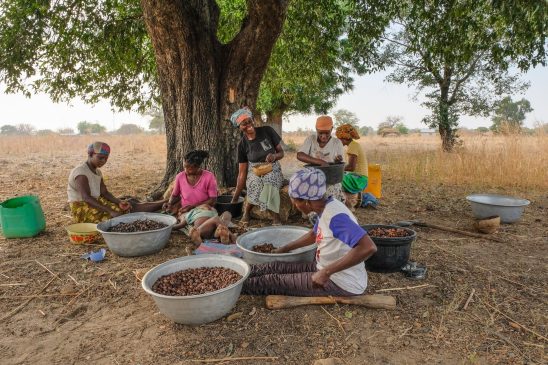
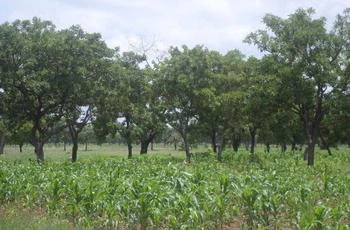
The NSZ of Ghana features roughly 400 million naturally occurring shea and other native trees across 78,000 square kilometres, making it a critical asset for both climate resilience and the rural economy.
Annual Output Capacity: The existing parklands possess the potential to yield up to 130,000 metric tons of shea products annually, providing a crucial livelihood for rural communities.
Beyond cosmetics, shea residue is being investigated as a highly affordable and low-cost alternative for livestock and aquafeed, which can lower poultry and fish farming costs.
Carbon Sequestration & Reforestation: Carbon sequestration is a competitive edge shea has over other indigenous tree species in Dagbon and the Savannah zone at large. Shea agroforestry parklands significantly improve soil conditions, mitigate heat, and provide a major adaptation tool against climate change.
Why Shea Parklands Matter for the Climate
Shea parklands (Vitellaria paradoxa) provide a unique blend of ecological and economic benefits:
Large-Scale CO₂ Removal: The billion+ shea trees spread across West Africa, along with associated parkland vegetation, sequester an estimated 1.5 million tons of carbon dioxide annually.
Significant Carbon Stocks: Studies evaluating above- and below-ground biomass in areas like Ivory Coast have found total carbon storage in these agroforestry systems can range from 70 to 215 tonnes of carbon per hectare, rivaling natural forest systems
Unlike traditional monocrop farming, the presence of shea trees in mixed farming systems stabilizes soil temperatures, limits erosion, and increases microbial activity, resulting in more carbon stored safely in the soil.
Exceptional Longevity: Shea trees are slow-growing and have a lifespan of 200 to 300 years, ensuring that the captured carbon remains securely stored in long-living woody biomass for centuries.
No Deforestation Required: Because shea grows naturally intertwined with subsistence crops (like millet, yam, and maize), they provide ecological benefits without requiring destructive land clearances.
Ongoing Investments and Restoration
Due to historical degradation and climate risks, massive interventions are actively protecting and expanding the resource base:
The Ghana Shea Landscape Emission Reductions Project (GSLERP)
Backed by the Green Climate Fund (GCF) and the United Nations Development Programme (UNDP), this multi-year initiative aims to restore 100,000 hectares of degraded shea parklands.
The project focuses entirely on the Northern Savannah Zone (NSZ) of Ghana, which spans across all five northern regions (Northern, Savannah, North East, Upper East, and Upper West).
In Dagbon, Northern Region the specific catchment areas of the project are, degraded reserves and parkland restorations, prominently within the Yendi District (such as the Balogu Forest Reserve) and nursery centers in Libga and Yipalgu.
“Overall Progress Achieved Since Project Start The Ghana Shea Landscape Emissions Reduction Project (GSLERP) operates on the theory that if the technical, governance, institutional and finance barriers to increase the value of trees and the shea value chain, non-timber forest products and ecosystem services in the landscapes in the NSZ, are removed, then deforestation and forest degradation will be reduced and adaptive capacity increased because communities will be able to maintain socially beneficial and financially viable management of lands and natural resources over the long term.
“It also assumes that if community and forest reserves are managed sustainably and shea is restored in the landscape, a host of economic, environmental and social benefits will accrue over the long term to the population in the Northern Savannah Zone.
“In line with this, the project has been implemented to align with this theory of change to achieve key project outcomes. GSLERP received its Notice of Effectiveness from the GCF on 10 May 2021 and received the first four disbursements of $2.3 million, $4.9 million, $5.1 million and $5.2 million in August 2021, December 2022, December 2023 and December 2024 respectively.
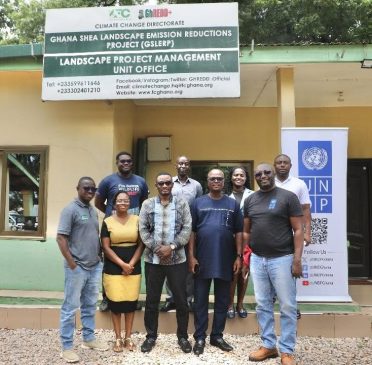
“The project has made progress with respect to all its four components since its inception, as will be seen from the detailed summary provided in Annex 1. In addition, a total of about USD12.1 million (almost 50%) out of the expected USD24.4 million has been mobilized as co-financing for the project” (Ref: Progress Report 2025)
Action for Shea Parklands (ASP)
Spearheaded by the Global Shea Alliance, this initiative seeks to plant millions of seedlings across the zone to support biodiversity and future harvests, alongside the creation of commercial community tree nurseries.
As part of its Sustainability Program, the Global Shea Alliance (GSA) is mobilizing industry stakeholders across the globe to ACT NOW and PRESERVE shea parklands. The three pillars, “Promote, Plant, Protect,” are mutually reinforcing.
The “Promote” and “Protect” aspects address long term and systemic factors behind the decrease in tree populations, while the “Plant” aspect showcases immediate change and impact.
While shea is the primary focus of the initiative, industry stakeholders are encouraged to include other indigenous trees in their implementation of the three pillars to ensure diverse and productive parklands.
Project Justification
Every year, an estimated 7,929,417 shea trees are lost across West Africa due to factors including climate change, lack of fallows, commercial agriculture, and tree removal.
If current trends continue, a projected shortage resulting in major interruption in the West African shea supply chain is anticipated by 2044. The realities of such predication will have major consequences on the income of millions of women collectors and processors as well as threaten industry sustainability and shea’s global competitiveness.
Enhanced Yields through Grafting
Substantial progress is being made in grafting shea seedlings to produce faster-fruiting varieties, dramatically increasing economic returns for local women collectors who previously had to wait decades for trees to mature.
Conclusion
The foregoing presentation on the socio-economic, ecological and climate importance of shea trees should thinker all and sundry with particular reference to Dagbon’s Youth Groups, traditional rulers, local authorities and Community Based Organizations to consider the protection, restoration conservation of shea parklands as a civic duty and responsibility to Dagbon, NSZ and Ghana.
The Dagbon Traditional Council and it’s counterparts in the other remaining four Northern Regions of the wider NSZ,may also consider putting in place a local communities focused legal and regulatory frameworks within the context of their traditional governance authorities to complement the efforts of the foreign organisations executing the all important project.