
By Issa Malgoubri, CEO of SGI Image Finances Internationales, Lead arranger and Lead placement manager
The first Sukuk of the State of Burkina Faso is not just a financial innovation. It is a national, regional, and international call to finance economic sovereignty through ethics, real economy, and trust.
There are operations that mobilize resources. And there are operations that mobilize a Nation.
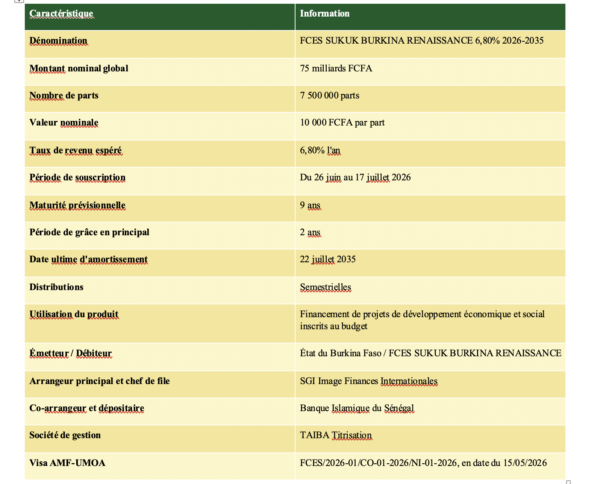
The launch of FCES SUKUK BURKINA RENAISSANCE 6.80% 2026-2035 belongs to this second category. With this issuance of 75 billion CFA francs, structured in the form of a Common Sukuk Issuance Fund, the State of Burkina Faso achieves a historic milestone: it opens to the public, institutions, the diaspora, and regional and international investors a modern, ethical instrument backed by real assets and aimed at financing the economic and social priorities outlined in the national budget.
This is not just a financial operation. It is an act of trust. It is an act of sovereignty. It is an invitation to all those who believe that the development of Burkina Faso must also be financed through the intelligent mobilization of national savings, the depth of the regional market, and controlled access to international capital.
The time has come to say a simple thing: our economic sovereignty is not just declared. It is financed. It is organized. It is structured. It is subscribed to.
A sovereign first for Burkina Faso
The Sukuk Burkina Renaissance marks the entry of the State of Burkina Faso into a financing universe that has already proven itself in many economies: that of Islamic market finance. For our country, this operation inaugurates a new way of speaking to savings: a more concrete, more readable, more inclusive way, more directly linked to the real economy.
The operation involves 7,500,000 units, with a nominal value of 10,000 CFA francs each, for a total nominal amount of 75 billion CFA francs. The subscription period is open from June 26 to July 17, 2026. The expected income rate is 6.80% per year, with semi-annual distribution, a projected maturity of 9 years, a grace period of 2 years on principal, and a final amortization date set for July 22, 2035.
Behind these figures, there is a rigorous architecture: the operation is authorized by the Financial Markets Authority of the UEMOA, structured with the support of SGI Image Finances Internationales as Lead arranger and Lead placement manager, with the Islamic Bank of Senegal as co-arranger and depositary bank, and TAIBA Titrisation as management company.
It is part of the regional financial market and the system applicable to Islamic financial securities in the UEMOA. But the essential point is elsewhere: for the first time, Burkina Faso gives each eligible investor the opportunity to participate in a sovereign Islamic finance operation, through a public offering, with an accessible entry ticket and a clearly assumed national ambition.
Understanding Sukuk: Islamic finance explained to all
Islamic finance remains, for many, a field surrounded by technical terms. Yet, its fundamental principle is of great simplicity: money should not generate money by itself; it should be linked to an asset, a service, a productive activity, a real economic risk, or a measurable utility.
It is based on a few major principles: the prohibition of usurious interest or riba, the limitation of excessive uncertainty or gharar, the exclusion of pure speculation and financial gambling, contractual transparency, backing by tangible assets, as well as a more responsible sharing of rights, obligations, and risks.
This does not make Islamic finance a finance reserved for a religious community. It is first and foremost a finance of discipline, traceability, and economic utility. It speaks to believers, of course, but it also speaks to rational investors, institutions, entrepreneurs, states, and citizens who want to know what their money is financing. A Sukuk, in simple terms, is an investment certificate that gives its holder economic rights linked to an asset or the usufruct of an asset.
Unlike a conventional bond, which is mainly based on a debt paid interest, Sukuk is based on income from an asset, such as rents, commercial profits, or contractual flows compliant with Islamic finance principles.
In the case of Sukuk Burkina Renaissance, the structure is based on public real estate assets whose usufruct is transferred to the issuing compartment, then leased to the State. The income distributed to holders comes from this regulated economic relationship.
The mechanism is therefore backed by identifiable assets and flows, under the control of the parties to the operation and the regional regulatory framework. For the non-specialist citizen, this means this: Sukuk is not an abstract promise detached from reality. It is linked to assets. It adheres to documentation. It fits into governance. It is understood. It is followed. It is verified.
For the financial expert, this means this: Sukuk brings a diversification of the investor base, a structuring in line with Islamic finance standards, mobilization through public offering, potential depth of the secondary market, and a useful articulation between sovereign assets, market liquidity, and development financing.
Why this mechanism is particularly suited to Burkina Faso
Burkina Faso needs long, stable, and quickly mobilizable resources to support its priorities. It needs infrastructure, education, health, public facilities, essential services, productive capacities, and economic confidence. It also needs instruments capable of speaking to institutional investors, companies, individuals, Burkinabe diaspora, and regional market partners.
Sukuk meets this requirement because it brings together three forces rarely combined in a single instrument: ethics, real asset, and collective mobilization. It is ethical because it is based on a logic of backing, transparency, and utility. It is real because it connects to assets and projects. It is collective because it allows multiple categories of investors to contribute according to their capacities, starting from a nominal value of 10,000 CFA francs.
The strength of a Nation is not only measured by its natural resources, budget, or partners. It is also measured by its ability to transform scattered savings into organized capital. In Burkina Faso, savings exist. They are in banks, companies, funds, families, cooperatives, businesses, liberal professions, associations, institutions, and the diaspora. They are sometimes cautious, sometimes informal, sometimes dormant. But they exist.
So the real challenge is not just to create savings. The real challenge is to channel them towards credible instruments. Sukuk Burkina Renaissance offers this channel. It gives national savings a destination. It gives investors a framework. It gives the country a lever. That is why this operation should be understood as a bridge: a bridge between the citizen and the State, between the financial market and development, between finance and ethics, between the present and the economic Renaissance of Burkina Faso.
National mobilization: every subscription counts
To every Burkinabe, I want to say this: subscribing to this Sukuk is not an ordinary gesture. It is not a donation. It is not a tax. It is an investment in a sovereign, structured, regulated instrument, bearing expected income and aimed at financing economic and social development projects.
The nominal value of 10,000 CFA francs is not a detail. It reflects a desire for inclusion. It says that popular savings have a place in national construction. It says that the financial market should not remain the business of a few insiders. It says that a student accompanied by their family, a young employee, an entrepreneur, a merchant, a professional, an institution, or a company can all, according to their means, participate in the same dynamic.
We must move away from a mistaken idea: a small subscription is never small when added to thousands of others. The economic history of Nations is often built this way: through the aggregation of acts of trust. What the individual cannot finance alone, the community accomplishes together through the market, through rules, and through trust. That is the spirit of this Sukuk: making savings an act of participation. Making subscription a common language. Making the financial market a popular, national, and strategic tool.
Regional and international mobilization: a signal to investors
Burkina Faso is not only addressing its domestic market. Through Sukuk Burkina Renaissance, our country is also speaking to the UEMOA, West Africa, regional institutional investors, funds, banks, insurance companies, pension funds, asset managers, and international investors sensitive to Islamic finance, economic impact, and portfolio diversification. The offer is made through a public offering in the UEMOA member states.
It is open to individuals and legal entities from member states, as well as regional and international institutional investors, in compliance with applicable legal restrictions. This is an essential dimension: the economic Renaissance of Burkina Faso is not isolated; it is part of a regional financial market, a trust dynamic, and a positive competition for capital.
For international investors, the message is clear: Burkina Faso is innovating, structuring, and diversifying. It is not just resorting to usual instruments. It is mobilizing a solution in line with Islamic finance requirements, backed by assets, regulated by the AMF-UEMOA, and supported by qualified market actors.
For the Burkinabe diaspora, the message is even stronger: here is a concrete, organized, and traceable way to transform attachment to the country into structured financial participation. Love for a country is powerful; when it goes through a well-regulated instrument, it becomes a force for development.
An accelerator for the national economy and the private sector
The scope of this operation goes beyond public financing. A successful sovereign Sukuk sets a precedent. It establishes a culture. It educates the market. It familiarizes investors with Islamic market products. It paves the way for future capital mobilization for companies, structuring projects, and productive sectors.
The Burkinabe private sector must watch this launch closely. Today, the State is paving the way. Tomorrow, industrial, agri-food, real estate, energy, commercial, or service companies can consider mechanisms compatible with Islamic finance to finance their assets, stocks, equipment, growth projects, or long-term needs. Islamic finance offers several families of useful instruments.
The Mourabaha can finance the acquisition of an asset through a sale with a known margin. The Ijara can finance an asset through a leasing logic. The Mousharaka organizes a capital and risk association. The Mudaraba connects a capital provider with a managing entrepreneur. The Istisna can support manufacturing or construction. The Salam can contribute to pre-financing productions, especially agricultural ones, when the structure is suitable.
These mechanisms are not slogans. They are tools. Well-structured, they can help finance SMEs, productive real estate, energy, agriculture, infrastructure, local industry, logistics, transformation, and national value chains. This is where Islamic finance can become an accelerator.
It can bring resources that remained on the sidelines due to a lack of products compatible with certain beliefs back into the formal circuit. It can attract regional and international capital looking for Sharia-compliant instruments. It can diversify sources of financing for the private sector.
It can strengthen project discipline, as it requires a better definition of the asset, contract, flow, risk, and governance. In an environment where access to financing remains a major challenge for businesses, any solution capable of expanding the investor base, mobilizing long-term savings, and linking finance to productive assets must be taken seriously. Sukuk Burkina Renaissance is not just an operation for today. It is a lesson for tomorrow.
An operation of trust, discipline, and responsibility
Trust is not claimed. It is built. It is built through clear documents, regulator authorization, quality of participants, compliance of the structure, transparency of terms, and everyone’s ability to understand the nature of what they are subscribing to.
That is why it is essential for every investor to read the Information Memorandum, consult their SGI, understand the characteristics of the operation, payment terms, risks, rights attached to units, applicable restrictions, and the provisional schedule. The mobilization we call for is not blind mobilization. It is informed mobilization. It is responsible mobilization. It is mobilization worthy of a modern financial market.
SGI Image Finances Internationales fully assumes its role in this operation: structuring, explaining, bringing investors closer to information, supporting placement, and contributing to making this Sukuk a reference for Burkina Faso and the region.
Subscribing is participating in the Renaissance
The name of this operation is not insignificant: Sukuk Burkina Renaissance. The Renaissance is not just a word. It is a requirement. It is a country’s ability to believe in its own strengths.
It is an economy’s ability to organize its resources. It is a society’s ability to transform trust into capital, capital into projects, and projects into collective well-being.
To citizens, I say: national savings is a power. Let us no longer underestimate it. To companies, I say: the financial market is not a distant space. It can become a lever for growth, structuring, and independence.
To institutions, I say: this Sukuk is an opportunity to strengthen the depth of the regional market and support a sovereign innovation. To the diaspora, I say: Burkina Faso offers you a concrete instrument to participate in its future.
To international investors, I say: Burkina Faso is opening a new chapter, with seriousness, innovation, and a sense of responsibility. Sukuk Burkina Renaissance calls for national, regional, and international mobilization. It calls for small savers and large investors. It calls for individuals and institutions. It calls for the heart, but also the mind. It calls for trust, but also analysis. It calls for ambition, but also discipline.
There are moments when a country’s economic history is played out in the ability of its citizens and partners to respond. That moment has come. The time has come to make savings a national force. The time has come to show that Burkina Faso can innovate, mobilize, and finance its trajectory.
The time has come to subscribe to FCES SUKUK BURKINA RENAISSANCE 6.80% 2026-2035. The Renaissance is not just told. It is built. It is financed. It is subscribed to.
SOURCE
FINANCIAL AFRIK