
Editorial Comment
“Emancipate yourselves from mental slavery None but ourselves can free our minds….” the late Bob Marley said it all, in his “Redemption Song” released in 1980 under one of his most popular albums, “Uprising”..
The need for Africa’s minerals resources rich countries to end the colonial legacy of raw minerals and other natural resources exports over dependency and to re-think, re-image, and re-set natural resource endowment to play a catalytic role in their development agendas, has become more imperative than ever before.
South-South Cooperation
The rising geopolitical tensions and their impact on Africa and the wider Global South seems to make South-South cooperation the more relevant and imperative. This is granted that, developing countries face similar socio-economic obstacles, allowing for highly relevant, practical, and replicable knowledge exchange rather than top-down western models
South-South Cooperation (SSC), a framework of collaboration among countries in the Global South promotes political, economic, and environmental solidarity based on equality and national sovereignty.
It accelerates development through peer-to-peer learning, cost-effective technology transfer, and localized solutions to shared structural challenges.
Africa-India Mutual Partnership
The fact that Asia represents the world’s largest concentration of gold demand and hosts advanced manufacturing industries, internationally recognised financial centres, commodity exchanges, institutional investors, and rapidly expanding technology ecosystems that increasingly influence the future direction of global bullion markets should interest Africa.
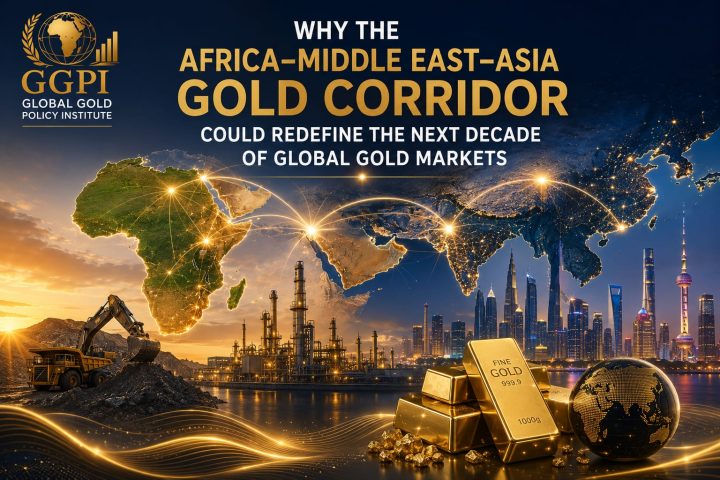
Leveraging the benefits of South-South Cooperation Africa could embark on a drive to unlock the continent’s gold and others including critical minerals economy through forging strategic partnership with India vis-à-vis, the emerging Africa–Middle East–Asia (AMEA) corridor as an increasingly interconnected economic and strategic gold ecosystem.
Enabler Role of Technology
Regulatory institutions and private sector players in the Africa’s gold trade industry would need to pay special attention to the use of modern technology as an enabler with particular reference to the Aurochain Protocol developed by the Aurum Elite Bullion that among others offers traceability and digital trade financing models alternatives at relatively lower cost.
Sustainable Mining Policy Frameworks
Ensuring responsible mineral extraction that is eco-friendly popularly referred to as “Green Mining” that seeks to strike a meaningful balance between wealth generation from mineral resources endowment and environmental health, for sustainability, should be non-negotiable.
For wealth generation through mining to be sustainable environmental stewardship, community engagement, and long-term governance minerals resources endowment would be crucial.
To this end, we of the Eco-Enviro News, Africa magazine, believe that governments of minerals resources rich countries in Africa, must endeavour to come out with public policy frameworks on Eco-friendly or Green Mining that would address responsible extraction, traceability among others.
Within the said policy frameworks, the ultimate would be taking pragmatic and measured action aimed at transitioning from the use of toxic gold extraction reagents like mercury and others, to the application of scientific research driven technological solutions via use of non-toxic gold extraction alternatives already out there in the market.
The Executive, legislature, Judiciary, policy formulation, implementation, evaluation and monitoring institutions in mineral resources rich Africa have to shirk off the colonial inferiority complex mindset and appreciate the need to also look from within than the overtly outside approach in order to drive the desired economic development impact.
The people in the various mineral resources rich African countries with particular reference to the teaming unemployed youth some of whom have to rough it out through oceans and dangerous desert paths to seek for greener pastures elsewhere, deserve much better.
Governments, regulators, industry associations, financial institutions, technology providers, research organisations have a crucial role towards unlocking Africa’s gold economy potential.
Africa’s Unique Selling Points
Africa holds an estimated $29.5 trillion in mineral resources and accounts for up to 60% of global critical minerals. The continent dominates the production of materials essential for green technologies—such as the Democratic Republic of the Congo (DRC) for cobalt, South Africa for platinum, and Guinea for bauxite.
Country Scenarios
Democratic Republic of the Congo (DRC) is endowed with roughly half the world’s cobalt reserves and produces two-thirds of mined cobalt globally, South Africa dominates the global supply of platinum-group metals (PGM) with 83% of reserves and is the leading producer of manganese, Guinea controls 26% of the world’s total bauxite reserves while Morocco on her part, holds 69% of global phosphate reserves.
Africa and the broader Global South represent the epicenter of the future energy transition. With reserves central to electrification, solar power, and electric vehicles, the continent’s untapped wealth is positioned to be a massive catalyst for economic transformation.
This established, it is however the strong belief of we at the Eco-Enviro News Africa magazine that, it is not what one has that matters most, but how one makes most productive and sustainable use of what one has, in other to maximize economic benefits from what one has, in the immediate, medium to long term, is what really matters.
Unlocking Africa’s $8.5 Trillion Mineral Wealth
With an estimated $8.5 trillion in untapped mineral resources and around 30% of the world’s critical minerals, leveraging these natural resources endowment as a tool for changing the continent and the larger Global South narrative should be non-negotiable
Historically, resource extraction has driven significant revenue but often failed to alleviate localized poverty or reduce inequality due to raw export dependencies making already rich countries derive a greater chunk of mineral extraction than where the actual mining is being done.
The new approach of targeting local value addition—refining ores at home, creating jobs to address Africa’s ballooning youth unemployment development economics expert contend already constitute national security risk warning if not addressed within the next decades an “Africa Spring’ may be inevitable.
The pragmatic action measures already being taken by a number of African countries namely Zimbabwe, Ghana, Uganda, among others, to move beyond exporting raw minerals to local refining for value addition and exports is the right way to go.
African governments and investors are mobilizing upwards of R2 trillion to strengthen critical mineral value chains locally in countries like South Africa. “Increasing fiscal revenues from natural resource extraction is an important step to ensure countries get their fair share and to boost much-needed public investment in their economies”(World Bank Blog)
To maximize this $29.5 trillion resource potential, the continent requires an on-going transition towards domestic refining, stronger fiscal resource governance policies, and improved regional energy infrastructure.