
…..As Mahama Officially Inaugurates Northshore Factory
Report: Mohammed A. Abu
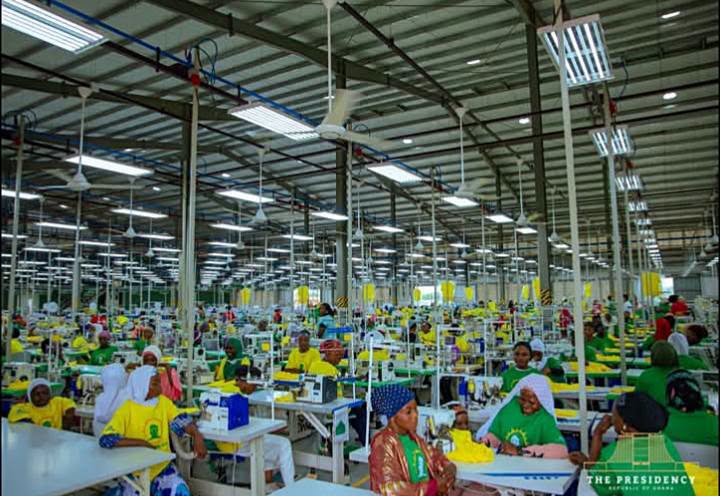
Ghana’s President Mahama has inaugurated his country’s Northern sector’s first sustainable and regenerative Northshore Apparel manufacturing hub, that uses zero-waste and renewable energy technologies.
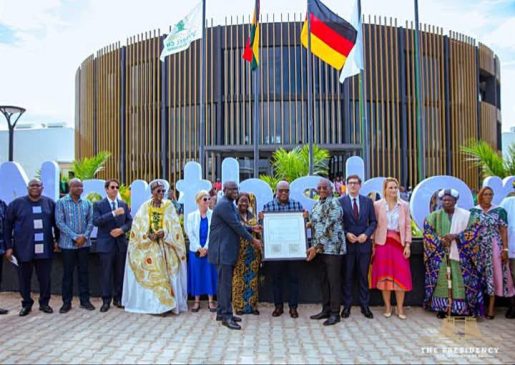
During the ribbon cutting ceremony in Savulgu, Friday, President Mahama while appreciating Alhaj Mohammed Nurudeen, the Founder and Chief Executive Officer of Northshore Apparel Ghana Ltd and partners, for their efforts and as well as, His Royal Highness, Yoo Naa Abdulai Yakubu Andani, the Paramount Chief of the Savulgu Traditional Area for donating land for the project, also expressed optimism that the facility would be able to generate at least about 30,000 jobs upon attaining full capacity.
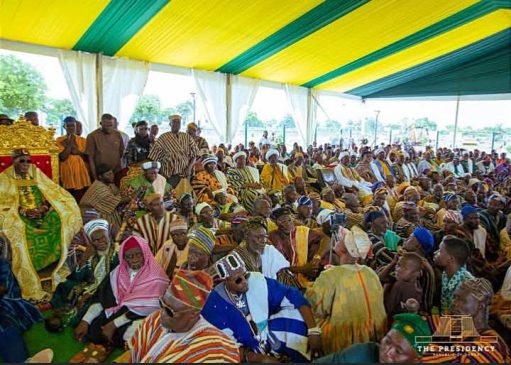
President Mahama underscored the relevance and importance of the project in addressing the decades long drifting of virile youth from the Northern sector to the Southern sector as a result of lack of job opportunities in their own backyard and thus, creating population imbalance.
He also noted that, the establishment of the Northshore Apparel Ltd shows the 24 Hour Economy could deliver on its mandate while also adding that the turning point of the nation’s economy was designed to achieve the creation of jobs and accelerated exports and Northshore satisfy’s both because it has already created about 2000 jobs.
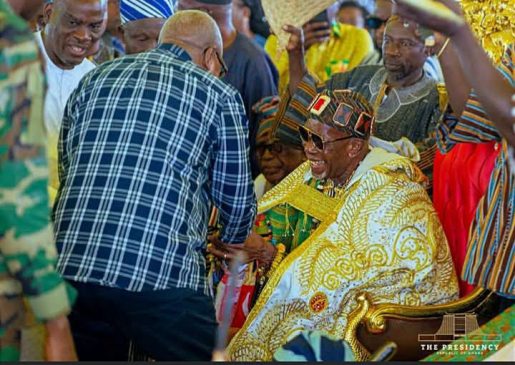
Present at the opening were the Minister for Trade, Agribusiness and Industry, Hon. Elizabeth Ofosu-Adjare; the German Ambassador to Ghana, H.E. Frederik Landshöft; Presidential Advisor on the 24-Hour Economy Initiative, Goosie Tanoh and the Chief Executive of the Ghana Export-Import Bank, Hon. Sylvester Adinam Mensah.
The Northshore Apparel Hub operations model aligns with government’s broader efforts to promote industrialization alongside environmental sustainability.
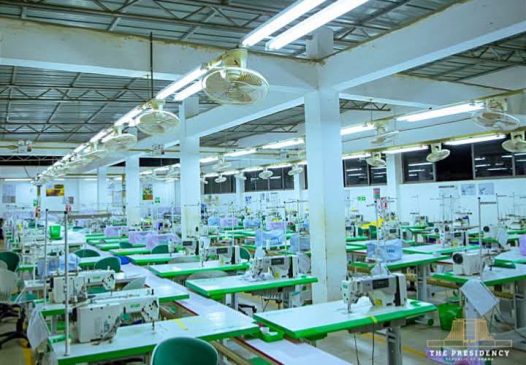
Located in the Savelugu Municipality, Northern Region, Northshore Apparel employs fabric optimization using digital tools like, Coats Digital’s GSDCost, FastReactPlan, and FastReactFabric solutions to enable precise costing, efficient production planning that reduces material waste.
Renewable Energy: The facility uses on-site solar power generation to reduce reliance on the national grid while in terms of water and waste management, the facility features water recycling systems and anaerobic biodigesters to maintain a zero-waste operating model.
Digital and Operational Infrastructure
Precision Planning: The plant utilizes GSDCost and FastReactPlan for efficient manufacturing workflows and projects up to 10,000 sustainable jobs when fully operational.
Social and Welfare Support
The facility provides free daily meals, on-site medical care, and a crèche for nursing mothers and training programs that target thousands of young workers in Northern Ghana to build employable skills
The Savelugu hub transforms reclaimed land into a state-of-the-art, zero-waste facility specializing in T-shirts, polos, fleece hoodies, children’s wear, sportswear, underwear, leggings, and trousers.
- Processed cereal grains: GH¢2.94 billion (8.1% of total food imports)
- Frozen chicken: GH¢2.84 billion
- Animal guts, bladders, and stomachs: GH¢2.72 billion
- Semi-milled or wholly milled rice: GH¢2.39 billion
- Broken rice: GH¢1.19 billion
- Other key items: Sugar, frozen fish, palm oil, mangoes, and shea nuts
Guided by the foregoing statistics, governments need more pragmatic policy framework designed to firmly position the country and move her away from an import dependent economy to an agro-processed products among other value added products driven economy. Scaling up both Foreign Direct Investment and domestic investments in the Northern sector should therefore be non-negotiable.
The Investment Opportunities offered to potential Investors
- Agribusiness and Agro-Processing: The region serves as a primary maize and grain basket, with abundant potentials in shea, groundnuts, livestock production, and value-addition facilities.
- Manufacturing and Industrial Hubs: Recent developments, such as the newly commissioned Northshore Apparel Hub in Savelugu, highlight growing opportunities in light manufacturing, textiles, packaging, and logistics. [1]
- Mining and Oil and Gas : Landmark initiatives like the Black Volta Gold project are expanding regional opportunities in mineral extraction, local supply chains,with particular reference to the recent announcement about the commencement of exploratory well drillings within the emerging Voltaian Basin onshore oil and gas prospect.
- Commerce and Tourism: Regional leadership—emphasized during events like the Northern Business Fair—actively promotes tourism, trade corridors, and commercial partnerships